
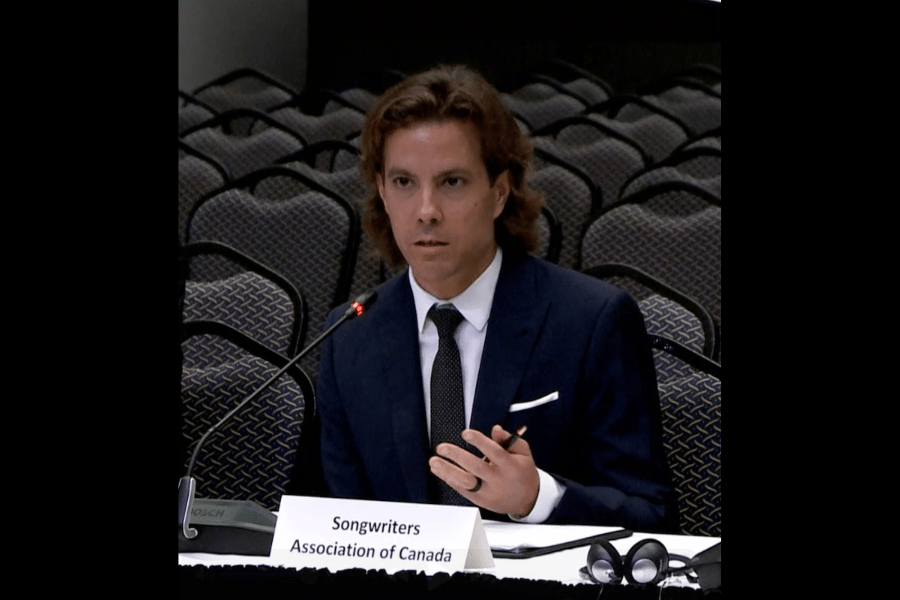
On Thursday September 25, S.A.C. President Arun Chaturvedi testified before the CRTC in Gatineau, Quebec, during their Broadcasting Notice of Consultation CRTC 2025-52: “The Path Forward – Supporting Canadian and Indigenous Audio Content”.
Read his full remarks below.
Chair, Commissioners, thank you for the opportunity to appear before you today.
My name is Arun Chaturvedi. I am here today as the President of the Songwriters Association of Canada (or, S.A.C.), which is a national not-for-profit organization that has advocated for the rights and livelihoods of music creators for over 40 years. We are a 100% Canadian organization, and our board is made up entirely of professional, working Canadian Songwriters.
I’m also a professional songwriter, composer, and music producer—and I make my living from making music. So today, I don’t just speak as a representative of songwriters—I speak as one of them, and I speak from the heart. I live the creative process every day, and I know what’s at stake here.
Songwriters are the people who create the intellectual property that powers the entire music industry. Without songs—without lyrics and melodies—there is no music business. No recordings, no concerts, no radio, and no streaming services. It all starts with the song.
Songwriters don’t receive salaries, and we’re typically not paid to create songs. We’re only paid after a song is commercially exploited: when it’s streamed, broadcast, used in film or television or performed live. If our songs aren’t played, we don’t get paid. It’s that simple.
So, content quotas and visibility obligations on radio and streaming services are not just cultural tools—they’re economic tools that allow us to provide for our families, pay our taxes, and contribute to the economic and cultural fabric of Canada.
Canada punches far above its weight on the global stage. We’re the third-largest exporter of music in the world, behind only the U.S. and the U.K. That remarkable success didn’t happen by accident—it’s the result of strong cultural policy. For over 50 years, Canadian content regulations and organizations such as FACTOR, Musicaction and Starmaker have created the conditions for Canadian music to thrive at home and abroad.
But, we’re here today because the system is at a crossroads. Streaming platforms are now the dominant way Canadians consume music. Unlike radio, they can be user-driven—but let’s be clear: they also shape listening through recommendations, playlists, and algorithmic curation. These are not simply passive platforms – they’re tastemakers. And as such, they have a vital role to play, like radio has for decades, in promoting Canadian music.
That’s why S.A.C. urges the Commission to require both traditional broadcasters and digital streamers to meet clear expectations when it comes to financially contributing to the creation of Canadian music and to promoting and recommending it prominently. Not one at the expense of the other—but both. And just as importantly, we need to be clear about what counts as Canadian music.
S.A.C. strongly supports and applauds the Commission, for its proposed “M-A-L” definition, which awards one point each for:
- M: where the music is composed principally by a Canadian
- A: where the principal artist is Canadian and,
- L: where the lyrics are written principally by a Canadian
This approach does three crucial things:
- It centres the song and the songwriter—the core creators of value in the music ecosystem and the voices uniquely positioned to tell Canadian stories.
- It reflects the modern collaborative nature of songwriting, allowing for shared credits and cross-border partnerships.
- It’s clear, transparent, and verifiable, using existing metadata and data from organizations such as SOCAN and The Canadian Musical Reproduction Rights Agency.
Some parties have suggested that the definition of Canadian content should align with public perception of what makes music Canadian. However, public perception should not override the need to ensure that actual Canadian music creators—particularly songwriters who frequently work behind the scenes but whose contributions are foundational—are supported.
Many members of the public are unaware that artists often do not write their own material. Regulatory definitions that determine the livelihood of music creators and the sustainability of Canadian culture must not be driven by public perception alone.
Songwriters are the ones creating the cultural products we’re trying to support. If we make them optional, we risk erasing the very foundation of our music industry, and our uniquely Canadian voice, identity and stories.
We are not asking for special treatment. We’re simply asking for recognition, fairness and regulatory consistency. For over a decade now, digital platforms have been allowed to operate in a regulatory vacuum, all in the name of innovation. And to what end? A system that enables foreign-based multinationals to dominate and monopolize Canadians’ digital listening and the digital music delivery ecosystem.
In closing, I return to the core idea: Canadian music starts with Canadian songs. And Canadian songs start with Canadian songwriters.
If we want a thriving, export-ready, diverse Canadian music industry, inclusive of Indigenous, Francophone and Anglophone voices, we must:
- Support the creators of the music
- Ensure their work is recognized in content definitions
- Maintain strong CanCon thresholds on all platforms
- Reinforce the funding infrastructure that makes all of it possible
- Allow Canadians to reclaim and retain their digital and cultural sovereignty
On behalf of the Songwriters Association of Canada, thank you for listening, and for recognizing the vital role of songs—and songwriters—in telling Canada’s story.